


Japan’s Most Inspiring Art Museums
- Feb 9
- 4 min read
A Design-Lover’s Guide by Region
Japan’s art museums are inseparable from their settings. Whether embedded in forests, hovering above cityscapes, or woven into island communities, these spaces reflect Japan’s deep sensitivity to form, material, light, and negative space. For travelers drawn to architecture, contemporary design, and curated environments, Japan offers one of the world’s most rewarding museum landscapes.
Below, Japan’s most inspiring art museums are grouped by region, highlighting destinations that resonate most strongly with design-conscious travelers.
TOKYO & KANTO ART MUSUEMS
Designed by Kengo Kuma, the Nezu Museum exemplifies contemporary Japanese restraint. A bamboo-lined approach, filtered natural light, and a contemplative garden experience make this as much an architectural pilgrimage as an art visit. The focus on pre-modern East Asian art appeals to travelers interested in material culture and form.

A compact yet influential institution known for boundary-pushing exhibitions. The building itself, designed by Mario Botta, contrasts sharply with its surroundings, appealing to travelers interested in postmodern architecture and experimental curation.
For context-driven travelers, MOMAT provides a structured narrative of Japan’s modern artistic evolution. Its calm spatial layout and proximity to green space make it ideal for thoughtful exploration rather than quick consumption.
KANSAI REGION ART MUSUEMS (KYOTO, OSAKA, HYOGO)
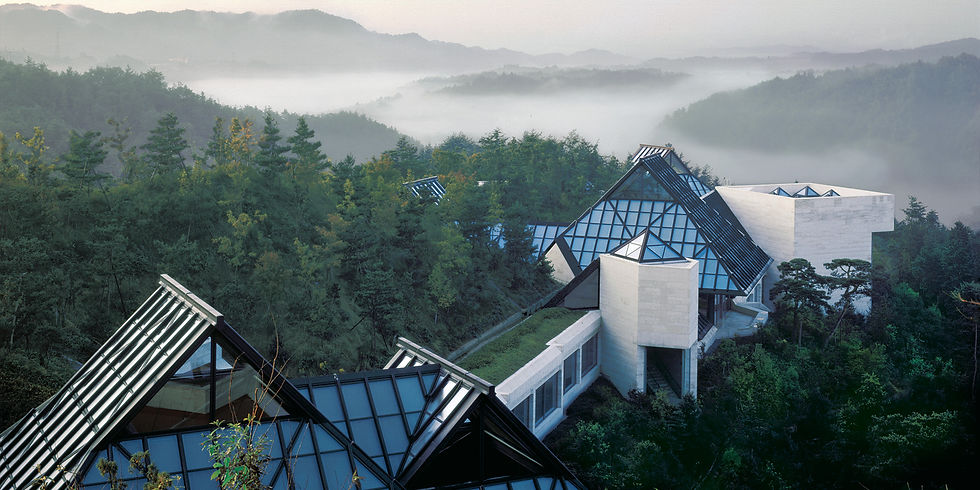
Miho Museum (Shiga)
Designed by I. M. Pei, the Miho Museum is a destination in itself. Approached via a tunnel and suspension bridge, the museum emerges gradually from the mountains, blending modernist architecture with natural serenity.
Recently renovated with a contemporary wing, this museum balances historical gravitas with modern exhibition design. It’s especially compelling for travelers interested in how Kyoto negotiates preservation and innovation.
A striking underground structure with an above-ground steel lattice inspired by bamboo. Its emphasis on postwar and contemporary art makes it a counterpoint to Kyoto’s historical focus.
Benesse Art Site Osaka (Satellite Exhibitions)
While best known for Naoshima, Benesse occasionally curates urban exhibitions in Osaka, appealing to travelers interested in experimental institutional formats.
SETO INLAND SEA & SHIKOKU ART MUSUEMS
Chichu Art Museum (Naoshima)
Designed by Tadao Ando, this subterranean museum redefines the museum experience. Artworks by Monet, Turrell, and De Maria interact directly with natural light, making time and weather part of the exhibition.
Benesse House Museum (Naoshima)
A hybrid of hotel and museum, allowing guests to experience art beyond opening hours. Ideal for travelers seeking immersive, slow cultural engagement.
Lee Ufan Museum (Naoshima)
Minimalist architecture paired with minimalist philosophy. The spatial dialogue between Lee Ufan’s work and Ando’s concrete forms is subtle and deeply intentional.

One of Japan’s most radical museum concepts. A single, organic structure housing a meditative installation where water, sound, and silence replace conventional art objects.
HOKURIKU & CHUBU REGION ART MUSUEMS
A transparent, circular building designed to democratize art access. The museum’s playful yet intellectually rigorous exhibitions have helped position Kanazawa as a design-forward regional city.
Housed in a building by Kengo Kuma, this museum celebrates material-focused artistry. Even travelers unfamiliar with glass art are drawn to the interplay of wood, light, and vertical space.

Recently reopened with a modernized campus and strong emphasis on landscape integration. Particularly appealing for travelers combining art with nature-focused itineraries.
CHUGOKU REGION ART MUSUEMS
World-renowned for its gardens, designed to be viewed as living paintings. Inside, the museum emphasizes modern Japanese painting, but the gardens remain the defining experience.

Situated along Lake Shinji, this museum is best visited at sunset. The emphasis on glass art and water reflections creates a strong sense of place.
HOKKAIDO ART MUSUEMS
Focuses on modern and contemporary Japanese art with a regional lens. Its location within a forested park aligns with Hokkaido’s broader emphasis on space and seasonality.
Moerenuma Park (Isamu Noguchi)
While technically a park, Moerenuma functions as a large-scale sculptural environment. Noguchi’s vision of landscape as art makes this essential for design-focused travelers visiting Hokkaido.

KYUSHU ART MUSUEMS
Rotating contemporary exhibitions staged within and around a major shrine complex. The contrast between sacred architecture and modern art creates a uniquely Japanese curatorial experience.
A solid introduction to both Japanese and Asian modern art, particularly valuable for travelers exploring Kyushu beyond its culinary reputation.
Planning a Design-Focused Art Journey in Japan
Rather than chasing famous names alone, design-minded travelers benefit most from regional depth. Pair museums with architecture, landscape, and accommodation choices that echo similar philosophies—minimal ryokan, design hotels, or rural stays.
Japan’s art museums reward patience. Many are intentionally remote, understated, or conceptually restrained. The payoff is an experience that feels less like sightseeing and more like participation.
Why Japan Is a Global Benchmark for Museum Design
In Japan, museums are not containers for art—they are part of the artwork itself. Light, material, silence, and movement are curated with the same care as exhibitions. For travelers who value design as experience rather than ornament, Japan remains unmatched.


Comments